Overview
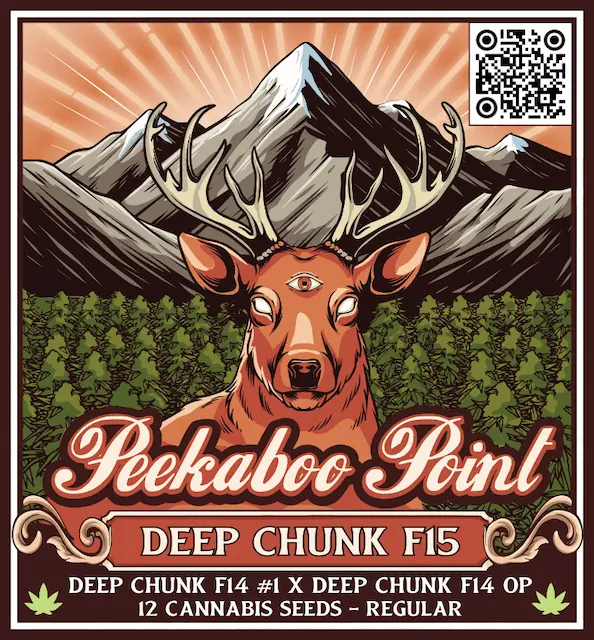
We’re grateful for the enduring legacy of Deep Chunk—a true cornerstone in breeding. Its structure, resin density, and earthy complexity make it a timeless foundation for new exploration.
In this open pollination, we worked with two Deep Chunk F14 males from Terpfi3nd Genetics. One expressed a balanced, classic kush profile—smooth, grounded, and steady—while the other carried darker undertones of chocolate and subtle bitterness, adding complexity and bite. Together, they offer a perfect harmony of approachability and depth, setting the tone for a richly layered next generation.
Deep Chunk F14 #1 stands as a classic expression of the original Tom Hill lineage . From Terp fi3nd Genetics, this pheno embodies everything Deep Chunk is known that captures the soul of the plant. This particular female leaned toward the traditional side of the spectrum — earthy, kush-heavy, and deeply grounded. Its compact structure and heavy trichome coverage made it a perfect foundation for stability and vigor. In this project, Deep Chunk F14 #1 served as the male parent in creating Deep Chunk F15, carrying forward the heritage of pure Afghan hashplant genetics into a new generation.